
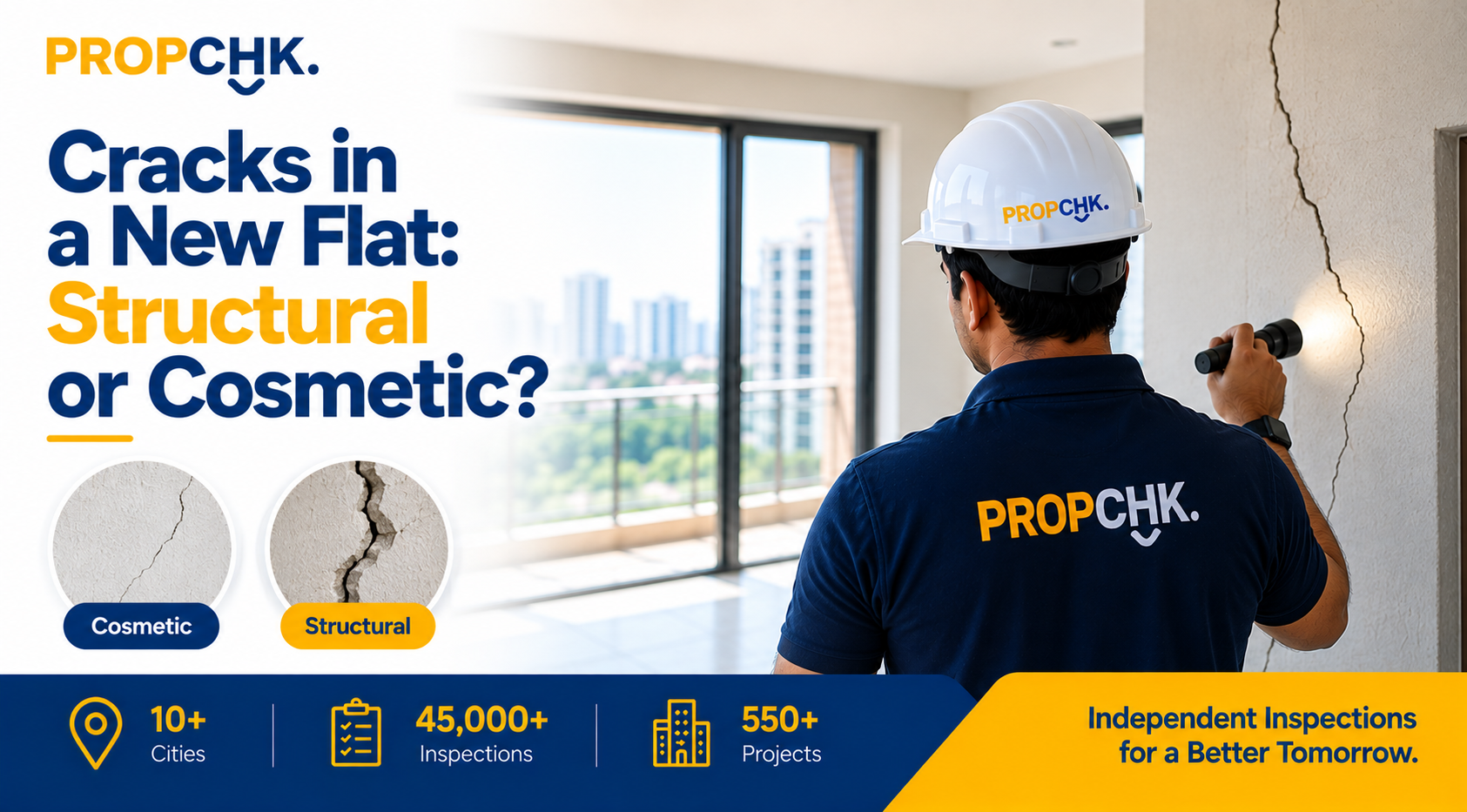
Most cracks in a new Indian flat are shrinkage cracks in plaster and are cosmetic. A crack becomes a structural concern when it is wider than about 3 mm, runs diagonally from a corner of a door or window opening, appears on a beam or column, or widens over successive months. Under Section 14(3) of the Real Estate (Regulation and Development) Act, 2016, a builder must rectify structural defects reported within five years of possession, at no cost to you.
What is a structural crack?
A structural crack is a crack that indicates movement or distress in the load-bearing frame of the building, which in most Indian apartments means the reinforced concrete columns, beams and slabs. Structural cracks typically appear on or adjacent to those members, run diagonally, pass through the plaster into the concrete or masonry behind it, and grow measurably over weeks or months.
Cosmetic cracks sit only in the plaster or paint layer. They are usually caused by drying shrinkage, thermal movement, or plaster applied too thick or too quickly, and they stabilise once the material has fully cured.
How to tell them apart
| Signal | Likely cosmetic | Likely structural |
|---|---|---|
| Width | Hairline to about 1 mm | Wider than 3 mm |
| Direction | Random, map-like, or vertical in plaster | Diagonal from opening corners, or along beam and column junctions |
| Location | Mid-wall plaster, ceiling corners | On columns, beams, slab soffits, or at slab-wall junctions |
| Depth | Stops at the plaster | Continues into masonry or concrete |
| Behaviour over time | Stable | Widens, lengthens, or new ones appear |
| Associated signs | None | Doors or windows binding, floor slope, spalling concrete, exposed reinforcement |
The single most useful thing you can do is measure. Mark each end of the crack with a pencil, write the date beside it, and photograph it with a scale in frame. Repeat after four weeks. A crack that has not moved is behaving like a cosmetic crack. A crack that has grown needs an engineer.
Common crack types in Indian apartments
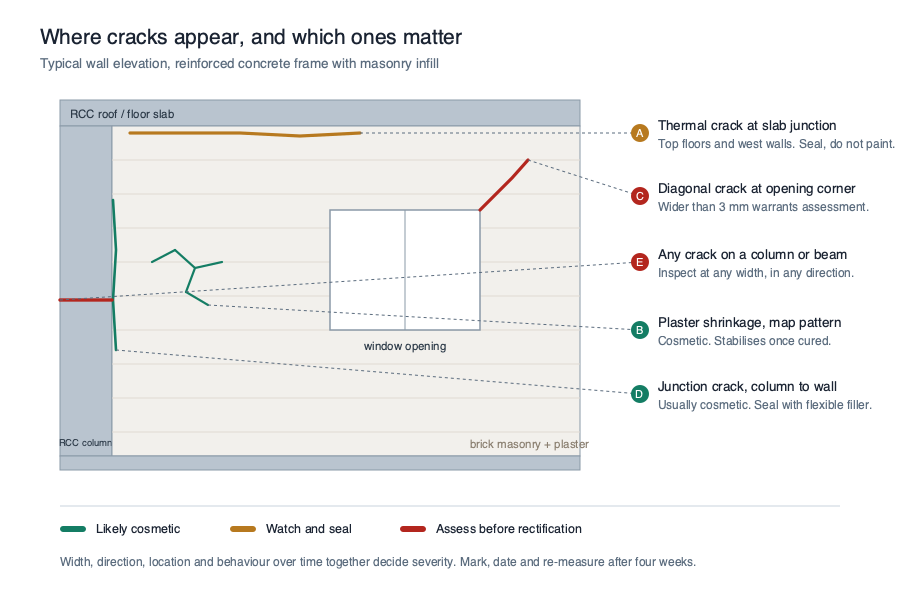
Plaster shrinkage cracks. Fine, random, map-like patterns across a plastered wall, usually within the first year. Caused by rapid drying or an over-rich mix. Cosmetic.
Thermal cracks at the top floor. Horizontal cracks where the roof slab meets the wall, most common on top-floor flats and on west-facing walls. Caused by the slab expanding in heat and the wall not moving with it. Usually not structural, but they let water in during the monsoon, so they need sealing rather than painting over.
Cracks at door and window corners. Short diagonal cracks running away from the corner of an opening. These are stress concentration points. Thin ones are common; a diagonal crack wider than about 3 mm at an opening corner warrants assessment.
Junction cracks between concrete and brickwork. Vertical cracks where a masonry wall meets a concrete column. Caused by the two materials moving differently. Usually cosmetic, but a persistent gap invites water and should be sealed with a flexible filler, not putty.
Cracks on columns and beams. Any crack on a column or beam, in any direction, at any width, should be inspected. Horizontal cracks on a column and diagonal cracks near a beam-column joint are the two patterns that most warrant a structural engineer.
Spalling with exposed steel. Concrete flaking away to reveal rusting reinforcement. This is not a crack question. It indicates inadequate cover or water ingress reaching the steel, and it should be assessed promptly because corroded reinforcement loses section over time.
How a professional inspection assesses cracks
A documented inspection produces measurements rather than adjectives. At PropChk, crack assessment during a handover inspection covers:
- Crack mapping with width recorded in millimetres at the widest point, and length and orientation noted per crack
- Depth checks to establish whether the crack stops at the plaster or continues into the substrate
- Moisture readings at and around the crack, since a crack that is also damp is a water path, not just a cosmetic defect
- Non-destructive testing of concrete where structural doubt exists, using rebound hammer or ultrasonic pulse velocity methods described in IS 13311
- Concrete cover checks, because inadequate cover over reinforcement is a common root cause of later cracking and spalling
- Photographic record with location and scale, so each crack can be re-measured on a later visit
Concrete quality and workmanship are assessed against IS 456:2000, the Indian Standard for plain and reinforced concrete.
What to do if you find cracks after possession
- Document before you report. Photograph each crack with a scale and a date. Note the room and wall.
- Get an independent assessment if any crack meets the structural signals above. A report from a qualified engineer carries more weight with a builder than a photograph.
- Report formally in writing to the builder, item by item, with locations. Keep the acknowledgement.
- Cite the defect liability period. Section 14(3) of RERA obliges the promoter to rectify structural defects and defects in workmanship reported within five years of possession, at no additional cost.
- Do not accept a paint-over. Filling and repainting a live crack hides it until the next monsoon. Ask what the rectification method is before it is carried out.
- Re-inspect after rectification. A crack is closed when it has been verified closed, not when it has been reported closed.
If the builder does not act, the matter can be escalated to your state RERA authority.
PropChk has completed 45,000+ inspections across 550+ projects in 10+ cities, with inspection processes designed in partnership with IIT Roorkee. The patterns described above are the ones our engineers record most often at handover.
Related reading
- Dampness in walls: types, causes and prevention
- Defect liability period
- 15 things to check before taking possession
The text of the RERA Act is available from India Code, and Indian Standards are published by the Bureau of Indian Standards.
Frequently asked questions
Are cracks in a new flat normal?
Fine plaster shrinkage cracks are common in the first year as materials cure and are generally cosmetic. Cracks wider than about 3 mm, cracks on columns or beams, and cracks that widen over time are not normal and should be assessed by an engineer.
How wide does a crack have to be before it is serious?
Width alone is not the whole test, but as a working threshold, cracks wider than roughly 3 mm merit professional assessment. Location and behaviour matter as much as width: a 1 mm diagonal crack on a column is more significant than a 2 mm random crack in mid-wall plaster.
Is the builder responsible for cracks after possession?
Under Section 14(3) of RERA, structural defects and defects in workmanship, quality or provision of services reported within five years of possession must be rectified by the promoter at no additional cost, or compensation is payable. Documenting the defect with dates strengthens the claim.
Can cracks be repaired permanently?
Cosmetic shrinkage cracks can be filled and finished once the material has stabilised. Structural cracks require the underlying cause to be addressed first; filling them without diagnosis means the crack returns. Thermal cracks at slab level usually need a flexible sealant rather than rigid filler.
Should I worry about cracks appearing after the monsoon?
Cracks that appear or widen after a monsoon often indicate water ingress or movement, and are worth assessing. Water reaching reinforcement is the mechanism behind most long-term concrete deterioration in Indian buildings.
Who should assess a crack, a contractor or an engineer?
A contractor will tell you how to fill it. An engineer will tell you why it is there. For any crack meeting the structural signals in the table above, get an independent engineering assessment before any repair is carried out.