

Yes. You are not obliged to sign a possession letter for a flat with unresolved major defects or one that materially differs from what was sold to you. But refusal is a negotiating position with a cost: your EMI, any rent you pay elsewhere and, under Section 19(10) of RERA, a two-month clock from the occupancy certificate to take physical possession. For most defect lists the better outcome is a documented conditional acceptance, with the defect register annexed to the possession letter and the builder on a thirty-day repair clock under Section 14(3). Outright refusal is the right tool for structural defects, a material area shortfall, a specification substitution, a missing occupancy certificate or non-functional services.
This page explains both routes and when each one is appropriate.
First, separate the two things you are deciding
Buyers usually collapse these into one question. They are different.
| Refusing possession | Accepting under recorded protest | |
|---|---|---|
| What you do | Decline handover until defects are rectified | Take the keys, with every defect recorded and annexed first |
| Leverage | Highest. The builder’s closure is blocked. | Moderate. Defects move into the Section 14(3) process with a thirty-day clock. |
| Your cost | EMI, rent elsewhere and delay continue; the two-month clock under Section 19(10) runs | You occupy; carrying costs stop |
| Best when | Defects are structural, or the flat differs materially from what was sold | Defects are numerous but rectifiable |
| Risk | Builder argues the delay is yours | A badly recorded protest weakens later claims |
Most defect lists are long but rectifiable. For those, accepting under a properly recorded protest, with a signed defect register, gets you into your home without giving up your claim. Refusal is for a smaller set of cases.
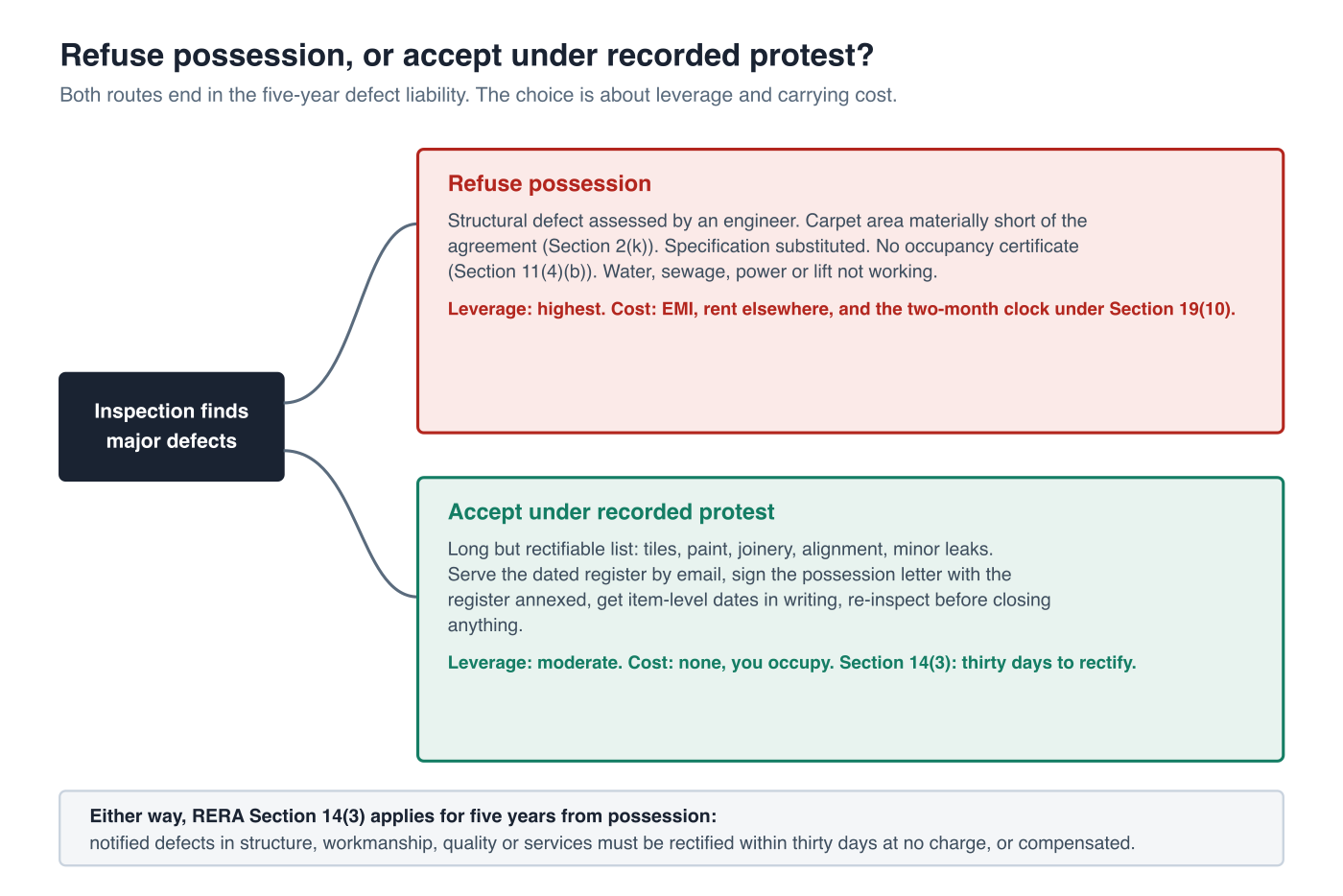
When refusal is the right call
- Structural defects. Cracking that an engineer assesses as structural rather than cosmetic, honeycombed or under-strength concrete, deflection, or any finding that affects the building’s integrity. Our guide to structural versus cosmetic cracks explains how the distinction is made.
- Material area shortfall. Carpet area delivered materially below the carpet area in your agreement for sale. RERA defines carpet area in Section 2(k); measure it, do not estimate it.
- Specification substitution. Fittings, brands or finishes materially below what the agreement specified.
- No occupancy certificate. Section 11(4)(b) puts the duty to obtain the occupancy certificate on the promoter. Taking possession without it means occupying a building not certified for occupation, and the two-month clock in Section 19(10) has not even started.
- Services not functional. Water, sewage, power or lifts not working at handover.
When accepting under protest is better
- Long snag lists of finishing defects: tiles, paint, joinery, door alignment, minor leaks.
- Anything the builder is actively rectifying and has committed to in writing with dates.
- Cases where your carrying cost of refusal is high and the defects are clearly fixable within the thirty-day clock.
How to accept under protest, properly
Done badly, this is the same as doing nothing. The sequence:
- Inspect before signing anything. An independent, dated report from a qualified engineer with measurements and photographs, not a walk-through note.
- Serve the defect register formally. Email it to the builder, numbered by severity, and ask for written acknowledgement. The date of this email starts the thirty-day clock under Section 14(3).
- Write the protest into the possession document itself. Do not sign a clean handover form that says you are satisfied with the condition. Add that possession is accepted subject to the attached defect list dated that day, and keep a countersigned copy.
- Get rectification timelines in writing, item by item where possible, inside the thirty days.
- Re-inspect after rectification. Do not close items on the builder’s assurance. Our guide to tracking builder repairs with a snag list shows how to keep the register live.
- Keep the whole file. You may need it up to five years later.
The single most common mistake is signing a satisfaction clause and raising defects afterwards by email. The signed clause is what the builder will point to.
What happens after possession either way
The builder’s obligation does not end at handover. Under Section 14(3), any structural defect, or any defect in workmanship, quality or provision of services, or any other obligation under the agreement for sale, brought to the promoter’s notice within five years of handing over possession must be rectified without further charge within thirty days. If it is not, the allottee is entitled to compensation under the Act. That is why documentation at handover matters so much: a defect recorded in a dated third-party report at possession is straightforward to attribute to construction. The same defect raised in month eighteen invites an argument about use.
If the list has multiple serious items and you are weighing repair, renegotiation or walking away, our guide on options after an inspection finds serious defects sets out the four routes side by side.
If the builder pressures you
Buyers report a familiar set of pressures at handover: that the offer of possession expires, that maintenance charges start regardless, that a third-party inspector is not permitted, or that the sale may be cancelled. Three things to hold onto:
- Put everything in writing. Verbal pressure disappears; email does not. Ask for any refusal or deadline in writing.
- A deadline is not a forfeiture. Section 19(10) gives you two months from the occupancy certificate to take possession. Read what your agreement actually says about the consequences of delay rather than accepting a verbal characterisation, and note that Section 19(6) and (7) make the allottee’s payment obligations run against the agreement, not against the builder’s verbal deadlines.
- Escalation exists. Section 31 lets any aggrieved person file a complaint with the state RERA authority or adjudicating officer against a promoter. Its existence changes the conversation even when you do not use it.
How PropChk fits into this
The decision above turns on the quality of the defect register. PropChk’s home inspection is carried out by qualified civil, electrical and mechanical engineers, independent of any developer, against protocols designed with IIT Roorkee, and produces a dated, photographed report graded by severity that can be annexed to a possession letter as it stands. Re-inspection after the builder’s rectification is a separate service so that closed items are verified, and area measurement is available where a carpet-area shortfall is suspected. PropChk operates in Delhi NCR, Mumbai, Pune, Bengaluru, Hyderabad and Chennai; you can book an inspection ahead of your handover date.
Frequently asked questions
Can I refuse to take possession of my flat?
Yes. You are not obliged to accept handover of a property that materially differs from what was sold to you or that has unresolved major defects. Refusal has carrying costs and Section 19(10) gives you two months from the occupancy certificate to take possession, so it is usually reserved for structural defects, material area shortfall, specification substitution, a missing occupancy certificate or non-functional services.
What is possession under protest?
Taking the keys while formally recording that you do not accept the property’s condition. Done properly it means a dated independent defect report, a formally served defect register, and wording on the possession document that acceptance is subject to that list. Done improperly, it is just taking possession.
Should I sign the possession letter if there are defects?
Not a clean one. Do not sign a clause stating you are satisfied with the condition while holding an open defect list. Add the qualification and attach the list.
How long does the builder have to fix defects I report?
Thirty days from your notice, for any defect notified within five years of possession, under Section 14(3). Failure to rectify within that time entitles you to compensation.
Can the builder cancel my booking because I brought an inspector?
Agreements for sale do not prohibit a buyer from bringing a technical consultant to the handover inspection. If cancellation is threatened, ask for the contractual basis in writing and preserve the correspondence.
Do maintenance charges start even if I refuse possession?
That depends on your agreement’s wording and on whether the offer of possession was valid, which is why the defect list should be documented before that date rather than after.
This article explains general principles and is not legal advice. Your rights depend on your agreement for sale and on the RERA rules of your state. Consult a lawyer before refusing possession or signing a qualified possession document. Reviewed by PropChk’s engineering team, 18 September 2026.
Sources
- The Real Estate (Regulation and Development) Act, 2016, Sections 2(k), 11(4)(b), 14(3), 19(3), 19(6), 19(7), 19(10) and 31: indiacode.nic.in
- Ministry of Housing and Urban Affairs, RERA: mohua.gov.in