

You can tell whether a home inspector is working for you or for the builder by checking five things before the visit and three things in the report. Before: who is paying, who introduced them, whether they inspect for developers on the same project, whether the engineer will put their name on the findings, and whether a sample report shows graded defects with photographs. In the report: whether every room and system has a finding or an explicit not tested, whether defects are measured rather than described, and whether the register is dated and served on the builder in writing. An inspector who fails the first set is conflicted; a report that fails the second set has been softened, whoever wrote it.
The worry behind the question is reasonable. In India the builder often controls access to the flat, sometimes offers a snagging visit with “our engineer”, and occasionally recommends an inspection company. The checks below separate an independent inspection from a builder-side walk-through, and they apply equally to verifying that a report you have been handed is genuine.
Five checks before the inspection
1. Who is paying the inspector?
The person who pays sets the incentive. If the builder is paying, or the fee is bundled into the possession charges, the inspector’s client is the builder, whatever they tell you on site. Pay the inspection company directly, on your own invoice, in your name.
2. Who introduced them?
A builder’s site office, a channel partner or a broker recommending “the inspection people we use” is a referral relationship, and referral relationships are paid for somewhere. Ask directly: does the company receive any fee, commission or volume of work from this developer? A straight answer is a good sign; a vague one is the answer.
3. Do they also inspect for developers on this project?
Many inspection companies, PropChk included, do pre-delivery quality inspections for developers as a separate line of business. That is not a conflict in itself. It becomes one when the same company is engaged by the builder on the same project you are buying into. Ask, and ask for the answer in writing.
4. Will a named, qualified engineer sign the findings?
An independent inspection is carried out by a civil, electrical or mechanical engineer who will put their name and qualification on the report. A “technician” from the builder’s snagging team will not. Ask who is coming, what they are qualified in, and whether their name appears on the document you receive.
5. Does the sample report show graded, photographed, measured defects?
Ask for a full sample report before booking, not a brochure. A genuine report grades each defect by severity, photographs it, gives a location and, where relevant, a measurement: crack width in millimetres, tile lippage in millimetres, moisture reading as a percentage, socket test result. A report that describes “minor finishing issues in bedroom 2” is a walk-through note. Our guide to evaluating a sample inspection report goes through the page-by-page checks.
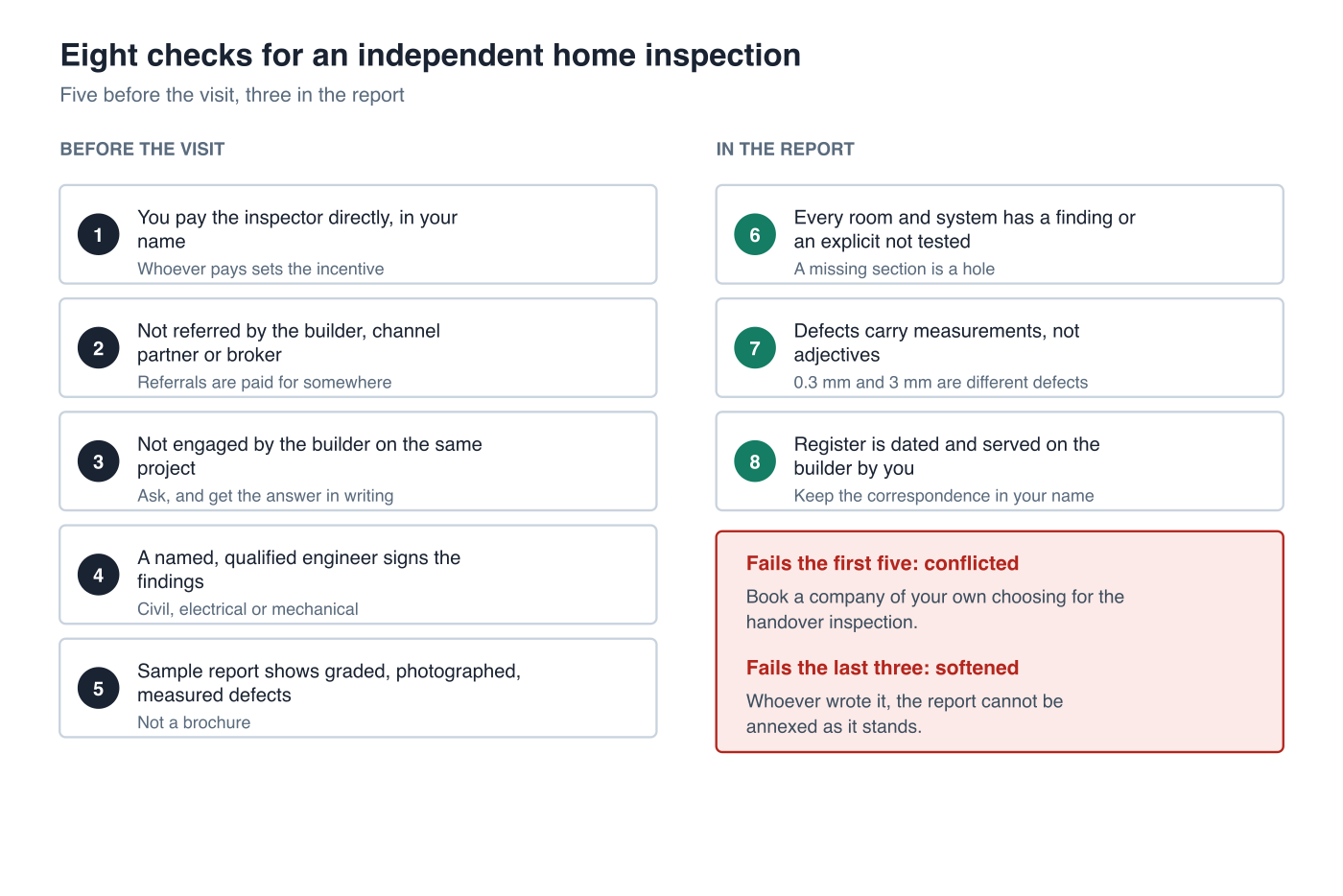
Three checks in the report itself
These matter even when the inspector passed every check above, because a softened report can come from pressure on site rather than from a payment.
- Coverage. Every room and every system should carry either a finding or an explicit not tested with a reason. A report with no electrical section because “power was not available” is honest. A report with no electrical section and no explanation has a hole in it. Our guide on what not tested means in an inspection report explains how to read those entries.
- Measurement. Defects should be measured, not adjectived. A 0.3 mm hairline crack and a 3 mm crack are different defects with different consequences; “crack noticed” tells you nothing. Moisture readings, lippage, level deviation and socket-tester results should appear as numbers.
- Date and service. The register should be dated, and you should serve it on the builder by email yourself, the same day. An inspection company that offers to “share it with the builder for you” is inserting itself into the correspondence; keep that correspondence in your own name.
How to verify that a report you have been given is genuine
Buyers on resale transactions, and buyers whose builder has offered a “third-party inspection certificate”, need a different check: is this document what it claims to be?
- Call the inspection company on the number from their own website, not from the report, and ask them to confirm the report number, the date and the address.
- Check the engineer’s name and qualification on the report against the company’s staff and, where the company publishes them, its credentials.
- Look for the tests that cannot be faked from a walk-through. Moisture readings, thermal images, socket-tester results and laser-measured areas leave a trail of numbers. A report with only photographs and adjectives may be genuine but it was not an instrumented inspection.
- Compare the date to the possession date. A report dated after possession was not a handover inspection, whatever it is called.
- Commission your own. If any of the above fails, or the stakes are high, a fresh inspection in your name costs far less than the defects it is meant to find. Our guide to the hidden defects an inspection uncovers gives a sense of what is at stake.
What the builder’s snagging visit is, and is not
Most builders offer a snagging or pre-possession visit with their own site team. Take it; it is free and it is the builder’s own record. But it is an internal quality check, run by people whose closure depends on the flat being accepted, and it produces a list the builder controls. It is not a substitute for an inspection whose only client is you. Do both, and compare the two lists; the difference between them is usually the most useful page you will read before handover. Our guide on whether an inspection is mandatory before possession sets out what the law does and does not require.
How PropChk stays independent
PropChk is an independent, third-party inspection company with no affiliation to any developer, agent or seller, and no referral fees. Buyers pay PropChk directly. Inspections are carried out by qualified civil, electrical and mechanical engineers against protocols designed with IIT Roorkee, using moisture meters, thermal scanners, socket testers, laser meters and TDS meters, and every finding is photographed, measured and graded in the report. Where PropChk does pre-delivery quality work for a developer, it is a separate engagement on a separate contract, and a buyer can ask whether that applies to their project before booking. PropChk operates in Delhi NCR, Mumbai, Pune, Bengaluru, Hyderabad and Chennai. You can read the inspection scope, download a sample report from the homepage, or book an inspection.
Frequently asked questions
How do I know my home inspector is not working for the builder?
Pay the inspector directly in your own name, avoid inspectors referred by the builder or broker, ask in writing whether the company is engaged by the builder on the same project, and insist on a named qualified engineer and a sample report with graded, photographed, measured defects.
Should I use the inspection company the builder recommends?
Not without asking whether the builder pays them, refers work to them or engages them on the project. If the answer to any of those is yes, book a company of your own choosing for the handover inspection.
How can I verify that a home inspection report is genuine?
Call the company on the number from its own website to confirm the report number, date and address; check the engineer’s name and qualification; look for instrumented results such as moisture readings and socket tests; and compare the report date with the possession date.
Is the builder’s free snagging visit enough?
It is worth taking, but it is the builder’s own quality check and produces a list the builder controls. An independent inspection produces a register whose only client is you, and the difference between the two lists is where the money is.
What should a genuine inspection report contain?
A finding or an explicit not tested for every room and system, defects graded by severity with photographs and measurements, the engineer’s name and qualification, and a date that precedes possession.
Reviewed by PropChk’s engineering team, 18 September 2026.