

A proper snagging inspection covers electrical and plumbing, but only if the flat has live power and water on the day and the inspector carries the instruments to test them. On the electrical side that means every socket checked for polarity and earth continuity with a socket tester, the residual current device tripped on test, the distribution board checked for labelling, MCB ratings and earthing, and switches, lights and fans run. On the plumbing side it means every fixture run under flow, drainage slope and trap seals checked, visible joints and shut-off valves inspected under pressure, hot-water supply confirmed and water quality spot-checked with a TDS meter. A snagging visit that ticks “electrical OK” and “plumbing OK” without those tests has looked at the fittings, not tested the systems.
Snagging in India usually means the builder’s pre-possession walk-through, focused on finishes: paint, tiles, doors, fittings. Those are the defects you can see. Electrical and plumbing defects are the ones you cannot, and they are the ones that cost the most after possession. This page sets out exactly what a snagging inspection should test in each system, what it takes to test it, and what to do when the flat is not ready to be tested.
Electrical: what is tested, with what, and what it finds
| Check | Instrument | What it finds |
|---|---|---|
| Every socket: polarity and earth continuity | Socket tester (RCD socket tester) | Reversed live and neutral, missing or open earth, which are the common causes of shocks from appliance bodies |
| Residual current device trip | Socket tester with RCD test, or the test button on the RCCB | An RCD that does not trip, or trips at the wrong current, leaves the flat without shock protection |
| Distribution board | Visual, multimeter | Unlabelled circuits, MCB ratings mismatched to cable size or load, loose terminations, missing earth bar connection |
| Voltage at sockets and at the board | Digital multimeter | Under- or over-voltage, phase imbalance in three-phase supplies |
| Earthing | Multimeter, socket tester | Earth pit not connected, high earth resistance, geyser and air-conditioner points without earth |
| Switches, lights, fans, bells, exhaust points | Operate each one | Dead points, wrong switch mapping, fan regulators not working |
| Concealed wiring and junction boxes | Visual at accessible points, thermal scanner on loaded circuits | Hot spots at joints, boxes without covers, cable runs without conduit |
The socket tester is the instrument that separates a snagging inspection from a walk-through. It is a plug-in device that reads polarity and earth on every outlet in seconds and, on the RCD variant, injects a test current to confirm the residual current device trips. A flat can have every socket plate straight and every switch working and still fail this test on half its outlets.
Plumbing: what is tested, with what, and what it finds
| Check | Instrument | What it finds |
|---|---|---|
| Every tap, shower, flush and outlet run under flow | Operate each one, timed fill where flow is weak | Low pressure, airlocks, cross-connected hot and cold, flush valves that do not seal |
| Drainage slope and trap seals | Spirit level, water test at each floor trap | Floor traps that hold water or drain the wrong way, missing or dry trap seals that let sewer gas in |
| Visible joints, valves and connections under flow | Visual, moisture meter | Weeping joints under basins and behind geysers, seized shut-off valves |
| Wet-area walls and floors | Moisture meter, thermal scanner | Concealed leaks behind tiles, seepage from the flat above, failed waterproofing |
| Balcony and bathroom floor slope | Spirit level, water test | Water standing away from the drain, which becomes dampness in the wall below |
| Water quality | TDS meter | Total dissolved solids far above expected for the source, which flags a tank or supply problem |
| Hot-water supply and geyser installation | Operate, check earth on the geyser point | No hot water at distant fixtures, geysers without pressure-release or earthing |
Most plumbing defects at handover are not visible. A floor trap that drains a half-degree the wrong way looks fine dry and floods the bathroom wet. A joint behind a basin weeps a drop an hour and shows up as a damp patch in the neighbour’s ceiling in month four. The tests above take an hour with water on and find them on the day.
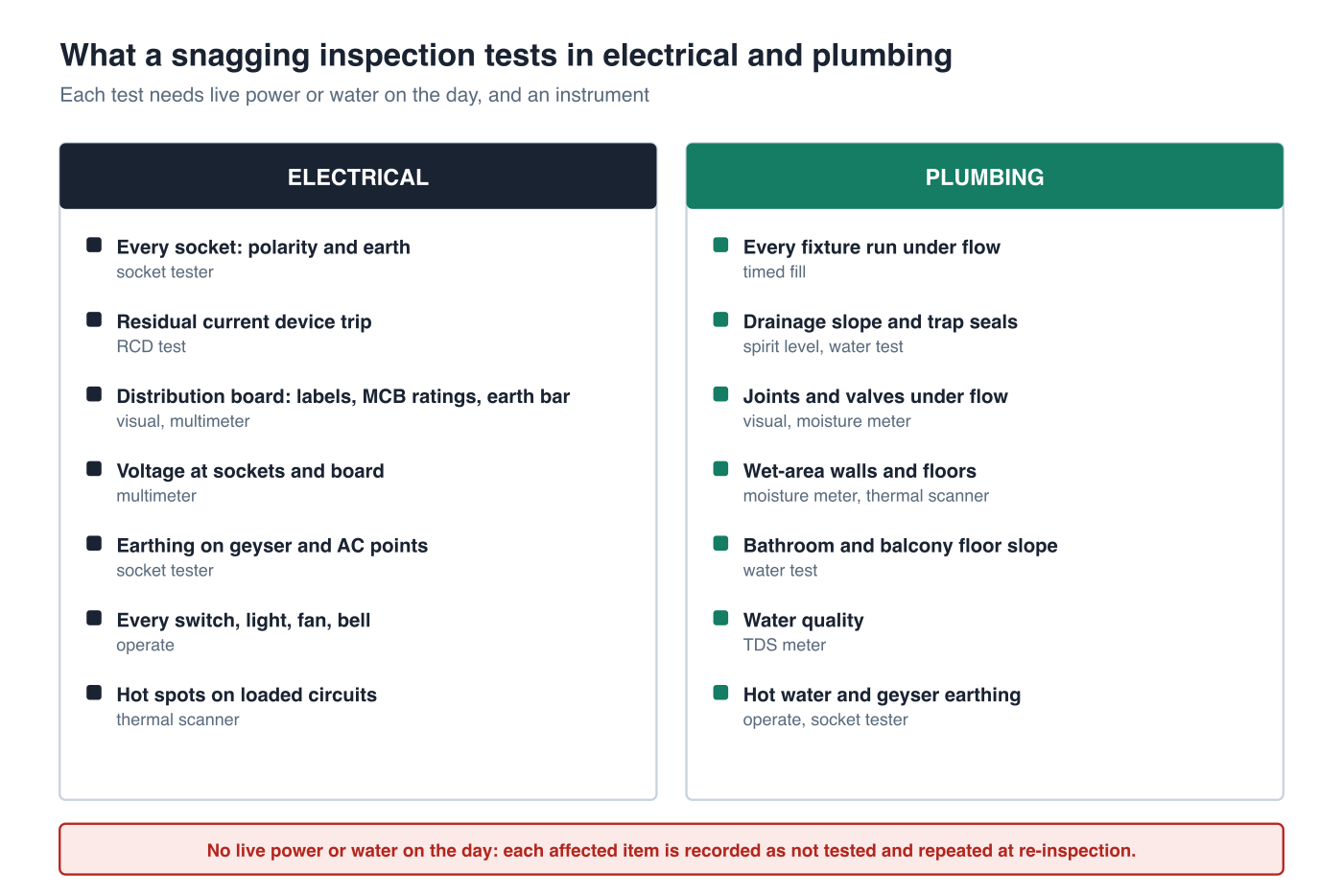
The condition that decides everything: power and water on the day
None of the electrical tests run without a live supply, and none of the plumbing tests run without water in the tank. New projects are often handed over with the meter not yet installed or the supply not yet released to the flat. Ask the builder in writing, before the inspection, to have temporary or permanent power and water available. If they are not, a competent inspector records every affected item as not tested with the reason, completes the structural, finish, dampness and area checks, and returns for the systems at re-inspection. Our guide on preparing a flat for inspection lists what to arrange, and our guide on what not tested means in a report explains how those entries are closed later.
What is out of scope, and why
A snagging inspection is non-destructive and works from accessible points. It does not open walls, pull cable, pressure-test the concealed water lines beyond what fixtures reveal, or certify the building’s electrical installation. Those are jobs for the builder’s contractor, a licensed electrical contractor or a specialist test. A good report says so explicitly rather than implying that a socket test is a wiring certificate. If a finding at an accessible point suggests a concealed problem, the report should recommend the specialist test, and that recommendation is itself a defect item for the builder’s register.
How the findings turn into repairs
Every electrical and plumbing defect goes into the same graded, photographed register as the finishing snags, with the instrument reading beside it. Served on the builder by email before you sign the possession letter, the register starts the thirty-day rectification clock under Section 14(3) of RERA, which covers defects in workmanship, quality and provision of services for five years from possession. A reversed socket and a weeping joint are inside that clause. Our guide to tracking builder repairs with a snag list covers the follow-through, and re-inspection is where the socket tester and the moisture meter come out a second time.
What PropChk’s snagging inspection covers
PropChk’s home inspection is carried out by qualified civil, electrical and mechanical engineers against protocols designed with IIT Roorkee. The electrical and plumbing tests above are part of the standard scope, using socket testers, digital multimeters, moisture meters, thermal scanners, laser meters and TDS meters, and every finding is photographed and graded in the report. A separate dampness inspection is available where seepage is the main concern, and re-inspection verifies the builder’s rectification. Our earlier guide to the tools a home inspector uses explains each instrument. PropChk operates in Delhi NCR, Mumbai, Pune, Bengaluru, Hyderabad and Chennai; you can read the full scope or book an inspection.
Frequently asked questions
Does a snagging inspection cover electrical and plumbing?
A proper one does, provided the flat has live power and water on the day. Electrical checks include every socket for polarity and earth, the RCD trip test, the distribution board and earthing. Plumbing checks include every fixture under flow, drainage slope and trap seals, joints under flow, wet-area moisture readings and a TDS reading.
What tools does an inspector use for electrical and plumbing checks?
A socket tester with RCD test, a digital multimeter, a thermal scanner, a moisture meter, a spirit level and laser meter for slopes and levels, and a TDS meter for water quality.
What if the flat has no power or water at the time of snagging?
The inspector completes the structural, finish, dampness and area checks and records each electrical and plumbing item as not tested with the reason. Ask the builder in writing to release supply, and have those items tested at re-inspection before they are closed.
Is a snagging electrical check the same as an electrical safety certificate?
No. Snagging tests are non-destructive checks at accessible points. A certificate for the installation is issued by a licensed electrical contractor after their own tests. A snagging finding that suggests a concealed fault should recommend that test.
Are electrical and plumbing defects covered by the builder’s defect liability?
Yes. Section 14(3) of RERA covers defects in workmanship, quality and provision of services notified within five years of possession, and the builder must rectify them within thirty days of notice at no charge.
Reviewed by PropChk’s engineering team, 18 September 2026.
Sources
- The Real Estate (Regulation and Development) Act, 2016, Section 14(3): indiacode.nic.in
- Central Electricity Authority (Measures relating to Safety and Electric Supply) Regulations, 2023: cea.nic.in
- Bureau of Indian Standards, IS 732 Code of Practice for Electrical Wiring Installations: bis.gov.in
- PropChk home inspection scope and tools: propcheck.in