

The problems found most often in Indian properties before purchase fall into six groups: dampness and water ingress, tiling and finishing defects, electrical safety faults, plumbing and drainage issues, structural cracking, and documentation gaps such as a missing occupancy certificate. Dampness is the most frequent and the most expensive to correct after possession, because water damages every other finish it reaches.
The six groups, and what each one actually is
Dampness and water ingress
The most common category in Indian residential property, and the one that worsens fastest. Sources are wet-area waterproofing failure, external wall penetration during monsoon, terrace slab leakage in top-floor flats, and concealed plumbing leaks.
Dampness matters beyond the stain. Persistent moisture reaching reinforcement causes corrosion and eventually spalls concrete. Correcting a waterproofing failure after finishes are in place means removing and reinstating those finishes, which is why the cost multiplies after possession.
Tiling and finishing defects
Hollow tiles, lippage between adjacent tiles, reverse falls in wet areas, and poorly finished joinery. Hollowness is the most under-detected because it is invisible: it requires tapping every tile and listening. Reverse falls in a bathroom mean standing water permanently.
Electrical safety faults
Missing or high-resistance earthing, reversed polarity at sockets, RCCBs installed but not functioning, and circuits loaded beyond rating. These are safety issues rather than comfort issues. Wiring installation practice in India is covered by IS 732.
Plumbing and drainage
Inadequate pressure at the highest fixture, concealed line leaks, poor trap and vent arrangement, and drainage that backs up when several fixtures run together. Tested by running everything at once rather than one tap at a time.
Structural cracking
Most cracks in a new flat are plaster shrinkage and cosmetic. The ones that matter run diagonally from opening corners, appear on columns or beams, exceed roughly 3 mm in width, or widen over successive months. Concrete quality is assessed against IS 456:2000, with non-destructive methods described in IS 13311.
Documentation gaps
The defects that are not physical. A missing occupancy certificate means the building is not certified for occupation. A carpet area shortfall against the agreement, as defined under RERA, is a commercial defect. Approved-plan deviations are a compliance defect. None of these appears on a walk-through.
Resale property versus new construction
The failure patterns differ, and so should the inspection.
| New construction | Resale property | |
|---|---|---|
| Typical defects | Workmanship: hollow tiles, lippage, earthing faults, reverse falls, shrinkage cracks | Ageing: waterproofing at end of life, corroded plumbing, wiring not matched to modern load, settled cracks |
| Who is liable | Builder, five years from possession under RERA s.14(3) | Generally the buyer after sale; original defect liability runs from the first possession date |
| Main purpose of inspecting | Build a defect register to get rectification before you sign | Price the property correctly and plan renovation |
| Documents to check | Occupancy certificate, carpet area against agreement, approved plan | Chain of title, past renovation quality, society records |
| Biggest risk if skipped | Signing away your claim on rectifiable defects | Buying a hidden repair bill |
For resale, the inspection question is not “will the builder fix this” but “what will this cost me, and should it come off the price”.
The order to fix things in
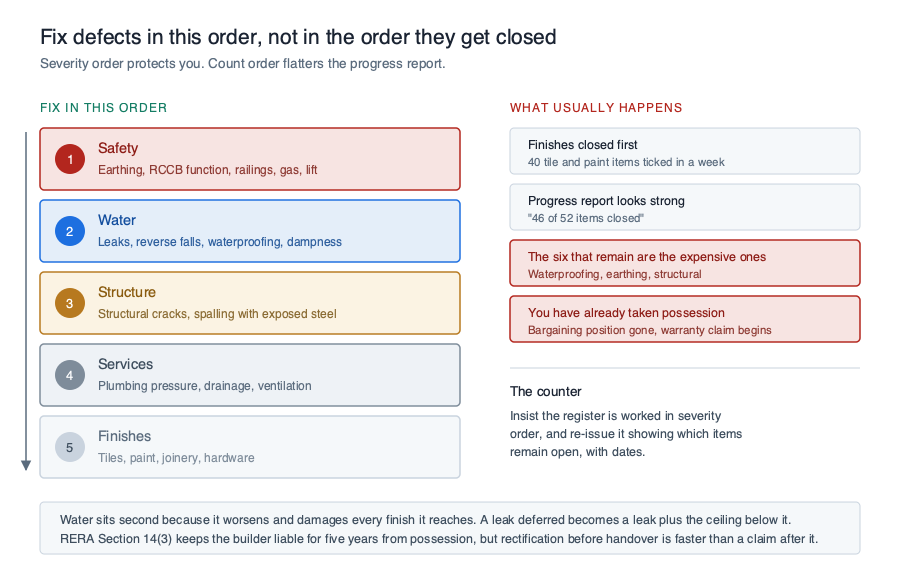
Not every defect deserves equal urgency. A workable priority:
- Safety. Electrical earthing, RCCB function, unsafe railings, gas and lift issues.
- Water. Leaks, reverse falls, waterproofing, dampness. These worsen and damage adjacent finishes.
- Structure. Any crack meeting the structural signals, spalling with exposed reinforcement.
- Services. Plumbing pressure, drainage, ventilation.
- Finishes. Tiles, paint, joinery, hardware.
Builders tend to close finishing items first because it shortens the list fastest. Insisting on severity order rather than count order is the most useful thing you can do while rectification is under way.
What an inspection produces
The output that matters is not a verdict but a defect register: each item numbered, located by room, measured, photographed, graded by severity, and mapped to the standard it breaches where one applies. That document is what you hand to a builder, and it is what you rely on if the matter is later escalated to your state RERA authority.
A report without measurements is difficult to act on, because every line becomes a matter of opinion.
When to inspect
Before signing the possession document. Under Section 14(3) of RERA the promoter must rectify structural defects and defects in workmanship, quality or provision of services reported within five years of possession, at no additional cost. That window is real, but bargaining position is strongest before handover is accepted, and attribution is easiest when the defect is recorded in a dated third-party report made before you held the keys.
PropChk has completed 45,000+ inspections across 550+ projects in 10+ cities, with inspection processes designed in partnership with IIT Roorkee. The patterns described above are the ones our engineers record most often at handover.
Related reading
- Dampness in walls: types, causes and prevention
- Defect liability period
- RERA carpet area and built-up space
The text of the RERA Act is available from India Code.
Frequently asked questions
What are the most common problems found in Indian properties before buying?
Dampness and water ingress, tiling defects including hollowness and lippage, electrical earthing faults, plumbing and drainage problems, structural cracking, and documentation gaps such as a missing occupancy certificate. Dampness is the most frequent and the most expensive to correct later.
What is the most expensive defect to miss?
Waterproofing failure, whether in wet areas or at the terrace slab. It presents late, damages finishes across the flat, and correcting it properly means removing and reinstating those finishes rather than patching.
Should I inspect a resale flat as well as a new one?
Yes, though for a different reason. On a new flat you are building a defect register to obtain rectification. On a resale you are pricing the property and planning renovation, because the builder’s defect liability generally does not transfer to you as a subsequent buyer.
What documents should I check before buying?
The occupancy certificate, the carpet area against your agreement as defined under RERA, and the approved plan against what has been built. These are defects that no physical inspection will reveal.
How many defects is normal in a new flat?
Counts vary widely by project and stage of completion, which is why the severity mix matters more than the total. A list of forty finishing items is routine; two structural items is not.
Can I use the builder’s own quality check instead?
The builder’s pre-delivery inspection is their internal quality process. It is not an independent assessment, and it is not the document that carries weight if rectification is disputed.