

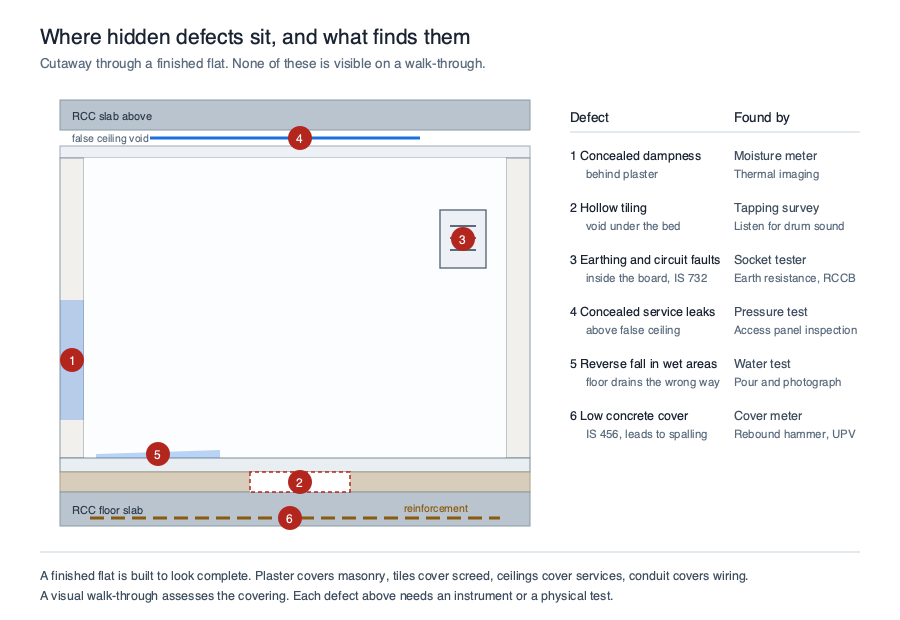
A professional home inspection uncovers defects that are invisible during a normal site visit because they are concealed behind finishes, only appear under load or water, or require instruments to detect. In Indian apartments the six that recur most are concealed dampness, hollow tiling, electrical earthing faults, plumbing leaks and low pressure, drainage and slope errors, and concrete quality problems including inadequate cover to reinforcement. None of these is visible on a Sunday viewing.
Why hidden defects stay hidden
A finished flat is designed to look complete. Plaster and paint cover masonry, tiles cover screed, false ceilings cover services, and conduits cover wiring. A visual walk-through assesses the covering, not what is underneath.
The defects that cost the most are the ones that present after possession: dampness that appears in the first monsoon, tiles that lift in the first year, earthing faults that are only discovered when something trips. Each of them is detectable at handover with the right instrument, and each is far cheaper to have rectified before you sign than after.
The six defects that recur most
1. Concealed dampness
Moisture in walls and ceilings before it becomes a visible stain. It originates from wet-area waterproofing failures, external wall penetration, terrace slab leakage in top-floor flats, or plumbing leaks inside chases.
Detected with a moisture meter and, where needed, thermal imaging. Readings are recorded as a percentage at a stated height and location, which is what makes them actionable. “Damp patch on the west wall” is not a defect report; “moisture 18.4% at 1.2 m on the west wall of bedroom 2” is.
2. Hollow tiling
Voids between tile and bed, caused by insufficient mortar coverage. Invisible, and detected only by tapping each tile and listening for a drum-like sound. Hollow tiles crack under point loads and lift at the corners, usually months after possession.
3. Electrical earthing and circuit faults
Missing or high-resistance earthing, reversed polarity at sockets, RCCBs that are installed but do not trip, and circuits loaded beyond their rating. These are safety defects, not comfort defects, and none of them is visible.
Detected with socket testers, earth-resistance measurement and by actually operating every RCCB and MCB rather than confirming its presence. Wiring installation practice in India is covered by IS 732.
4. Plumbing leaks and inadequate pressure
Concealed line leaks inside walls and floors, inadequate flow at the highest fixture, poor trap and vent arrangement, and drainage that backs up under simultaneous use.
Detected by pressure testing concealed lines, running every fixture, and testing flow at the least favourable outlet rather than the most convenient one.
5. Drainage and slope errors
Floors in bathrooms, balconies and utility areas that do not fall towards the drain, or fall the wrong way. The result is standing water permanently, and dampness in the wall below over time.
Detected with a water test, which is the cheapest and most persuasive check available. Pour water and watch where it goes.
6. Concrete quality and cover
Inadequate cover over reinforcement, honeycombing, and low-strength concrete. Inadequate cover is the root cause of most long-term deterioration in Indian reinforced concrete buildings, because it allows moisture to reach the steel, which then corrodes and spalls the concrete off.
Assessed against IS 456:2000, using cover meters and non-destructive testing methods described in IS 13311, such as rebound hammer and ultrasonic pulse velocity.
Defects by where they hide
| Location | What hides there | How it is found |
|---|---|---|
| Behind plaster | Dampness, concealed pipe leaks, cracks continuing into masonry | Moisture meter, thermal imaging |
| Under tiles | Hollowness, uneven bedding, missing waterproofing in wet areas | Tapping survey, water test |
| Above false ceilings | Leaking services, poor duct routing, unsupported wiring | Access panel inspection |
| Inside conduits and boards | Earthing faults, reversed polarity, undersized circuits | Socket testers, earth resistance, RCCB operation |
| In concrete | Inadequate cover, honeycombing, low strength | Cover meter, rebound hammer, ultrasonic pulse velocity per IS 13311 |
| At external junctions | Window and door frame sealing failures, driven-rain paths | Water spray test, moisture readings |
| On the terrace (top floor) | Waterproofing failure, reverse falls, choked outlets | Ponding test, slope check |
What separates an inspection from a walk-through
Three things: instruments, standards and documentation.
Instruments, because moisture, earthing, concrete quality and level cannot be judged by eye. A moisture meter, thermal camera, socket and earth testers, rebound hammer, spirit level and measuring tools are the minimum for a residential handover inspection.
Standards, because a report that cites IS 456 for concrete, IS 732 for wiring, IS 1200 for measurement and IS 13311 for non-destructive testing is a technical assessment. A report citing nothing is one person’s opinion.
Documentation, because the report’s purpose is to be handed to a builder. Each defect needs a number, a location, a measurement, a photograph and a severity, so it can be tracked to closure.
When to inspect
Before you sign the possession document. A defect list carries its full weight only in the window before handover is accepted. After that, defects move into the five-year window under Section 14(3) of RERA, in which the promoter must rectify defects in structure, workmanship, quality and services at no additional cost. That protection is real but slower, and it puts the burden on you to show the defect is a construction defect rather than wear.
PropChk has completed 45,000+ inspections across 550+ projects in 10+ cities, with inspection processes designed in partnership with IIT Roorkee. The patterns described above are the ones our engineers record most often at handover.
Related reading
- Dampness in walls: types, causes and prevention
- Apartment inspection checklist before moving in
- Why home inspection services matter
Indian Standards are published by the Bureau of Indian Standards.
Frequently asked questions
What defects can a home inspection find that I cannot see myself?
Concealed dampness, hollow tiling, electrical earthing faults, concealed plumbing leaks and low pressure, drainage slope errors, and concrete defects such as inadequate cover to reinforcement. All six require instruments or a physical test to detect.
How long does a home inspection take?
A 2 BHK apartment inspected properly takes several hours; villas take longer because the roof, compound, façade, drainage and independent water systems are added to the internal scope. Ask for hours on site and number of engineers in writing before booking.
What equipment should an inspector bring?
At minimum a moisture meter, thermal imaging camera, socket and earth-resistance testers, rebound hammer or ultrasonic equipment for concrete, spirit level and measuring tools. An inspection carried out with a torch and experience is a walk-through.
Are hidden defects the builder’s responsibility?
Yes, within the defect liability window. Section 14(3) of RERA obliges the promoter to rectify structural defects and defects in workmanship, quality or provision of services reported within five years of possession, at no additional cost.
Is a home inspection worth it for a flat from a reputed builder?
Developer reputation affects how quickly defects are fixed, not whether they exist. Concealed dampness, hollow tiling and earthing faults occur across price points because they arise from workmanship on site rather than from brand.
Can I inspect the flat myself before hiring anyone?
You can catch cosmetic and functional issues yourself: operate every tap, switch and door, and pour water in the wet areas to watch where it drains. What you cannot catch without instruments is exactly the list above, which is where the expensive defects sit.