
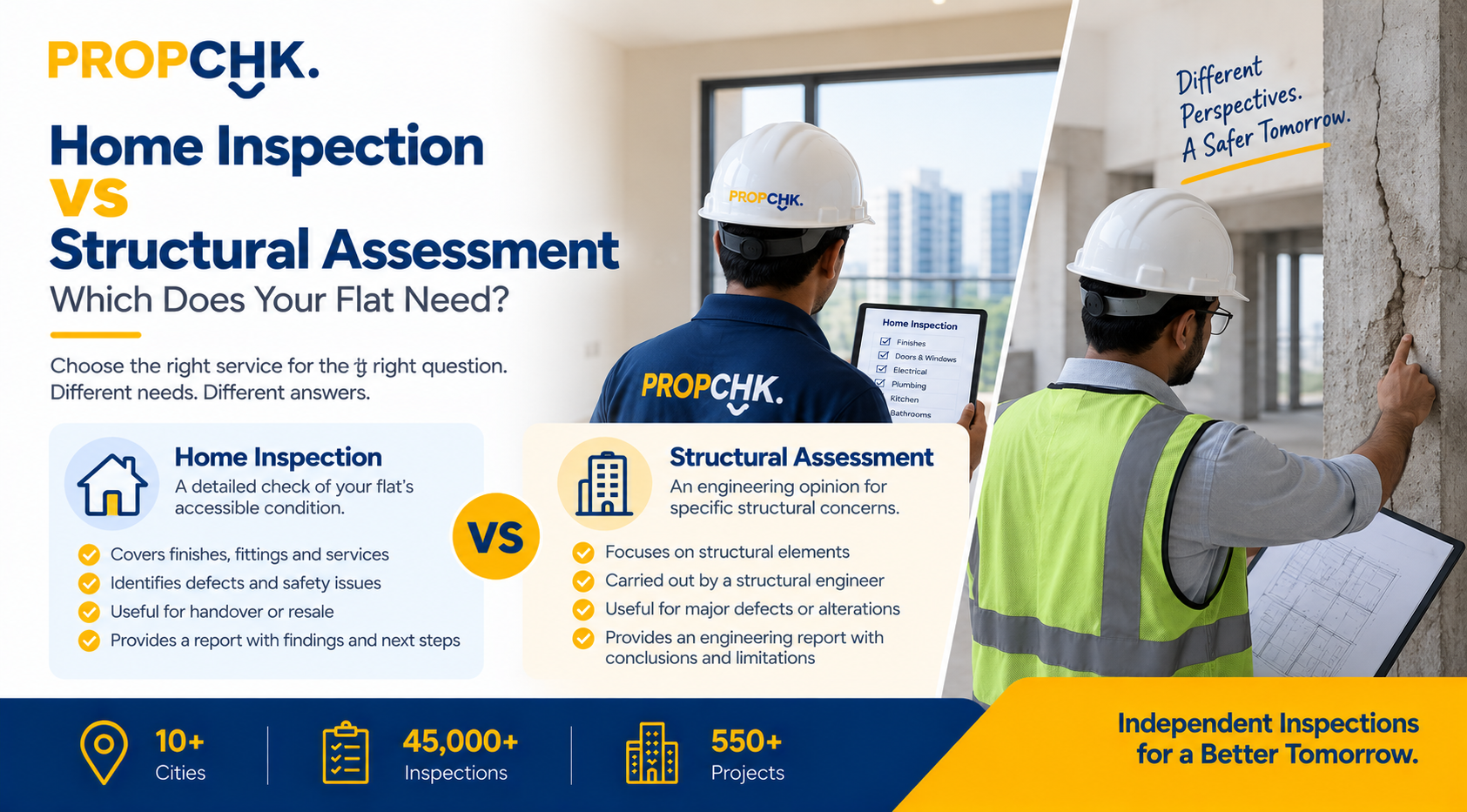
Choose a home inspection when you need a record of your flat’s accessible condition and the checks included in that service. Choose a structural engineer’s assessment when you need an engineering opinion about a structural concern or proposed alteration. Agree the question, areas covered and written deliverable before booking. The service name alone does not establish what will be assessed.
The two services can complement each other. A home inspection may identify an observation that warrants specialist review, while an engineer’s targeted assessment may leave everyday fittings and finishes outside its scope. Start with the decision you need to make, then commission work that can answer it.
How do the services differ?
| Question | Home inspection | Structural assessment |
|---|---|---|
| What is the main purpose? | Record condition and findings within the agreed home inspection scope. | Address a defined structural engineering question. |
| What might be covered? | Accessible finishes, fittings and agreed checks of building services. | Specified structural elements, records and investigations relevant to the concern. |
| Who should explain the scope? | The inspection provider. | The structural engineer responsible for the assessment. |
| What should you receive? | A report identifying observations, recommended next steps and limitations. | The agreed engineering report, with its basis, conclusions, limitations and any recommended further work. |
| What should you avoid assuming? | That the service establishes whole-building structural adequacy. | That every fitting is checked, all testing is included or a safety certificate will automatically be issued. |
This is a guide to choosing scope, not a universal specification. Providers use terms such as survey, inspection, audit and assessment differently. Ask what the proposed work includes in your particular case.
When is a home inspection the useful starting point?
A home inspection is a useful starting point when your question concerns the condition of the flat across a range of accessible items. For example, you may want a documented list of observations before handover or a review of the condition of a resale flat.
PropChk’s home inspection service is the relevant place to discuss checks for your property. Request the actual scope, access requirements and report format. Ask which operational checks depend on utilities or completed installations and how untested items will be reported.
Hypothetical example: an owner wants a room-by-room record of finish damage, door operation and agreed plumbing checks in a newly completed flat. A general home inspection may fit that question. The owner should still confirm the individual checks rather than infer coverage from a broad package name.
When should you speak to a structural engineer?
Speak to a structural engineer when the question requires an engineering judgement about the structure. That could involve a concern referred by an inspector, a proposed alteration that may affect structural elements, or a need to understand the implications of reported structural damage.
Describe the observation without diagnosing it. Give the location, when it was first noticed, whether it has changed and any relevant work history. A photograph can help explain what prompted your enquiry; it should not be treated as sufficient evidence to declare a structure safe or unsafe.
Hypothetical example: a flat owner wants to remove a wall and asks whether the change is structurally acceptable. A routine condition inspection does not answer that design question. The owner should discuss the proposal with an appropriate engineer and arrange the necessary assessment before work proceeds.
If a condition appears immediately dangerous, keep people away from the affected area and seek urgent on-site assistance through building management and appropriate local services. A planned routine inspection is not an emergency response.
Does a structural assessment always include tests?
No. The method depends on the question and the engineer’s proposed scope. An initial visit may lead to a recommendation for records, monitoring or further investigation. Do not assume that every quoted assessment includes material tests, calculations, opening-up work or repair design.
Ask why any proposed investigation is needed, what it can establish and what limitations remain. If access or opening-up is required, agree responsibility for permission, coordination and making good before work starts.
The Institution of Structural Engineers’ guidance on surveys and inspections emphasises discussing and agreeing limitations when commissioning an engineer. Use that principle to make your brief specific. This international guidance is background reading, not a statement of local statutory requirements.
What documents should you prepare?
Send a concise description of the question before sending a large folder. Let the engineer identify the records relevant to the work. Depending on the concern, useful material to discuss includes:
- The existing inspection report and the exact item requiring further review.
- Dated photographs and a factual record of changes you have observed.
- Available structural and architectural drawings, identified by type and revision.
- Records of past alterations, repairs or earlier assessments.
- Information about access restrictions and who can authorise access to shared areas.
Do not assume an architectural floor plan contains the structural design information the engineer needs. If a requested record is unavailable, say so. The engineer can explain how missing records affect the proposed assessment or whether further work is necessary.
For an apartment, some relevant elements or records may be outside your individual flat. Coordinate with the owner, association or building management as appropriate. A visit confined to one unit should not be presented as a whole-building assessment unless that is actually the commissioned scope.
What should you agree before accepting a quote?
Compare proposals using the question they answer, rather than price alone. A short visit to one concern and a broader investigation are different pieces of work.
- The question: state the decision you need the report to inform.
- The coverage: list the locations and elements included, along with access limitations.
- The method: clarify whether the proposal includes visual review, document review, calculations or particular investigations.
- The deliverable: ask what the written report will contain and what it will not conclude.
- The next stage: establish whether repair design, further tests or follow-up visits are separately commissioned.
Ask who will be responsible for the assessment and about their relevant experience and credentials. If a certificate or report is needed for a particular recipient, disclose that purpose early and confirm the recipient’s requirements. Do not assume a general report will satisfy them.
Frequently asked questions
Can a home inspector refer an issue to a structural engineer?
Yes. Ask the inspector to identify the observation and the question requiring specialist review. A referral identifies a need for further assessment; it is not by itself a diagnosis of structural failure.
Can I choose the service from a photograph of a crack?
A photo can help a professional understand your enquiry, but it does not establish the cause or the full assessment needed. Provide location and history, then ask what on-site review is appropriate.
Does an engineer’s visit automatically produce a safety certificate?
No. Agree the purpose and deliverable before booking. A targeted assessment, a design opinion and a certificate requested for a specific purpose may involve different work and requirements.
Will a structural assessment replace my snagging inspection?
Only to the extent that its written scope covers the same questions. A targeted engineering assessment may not cover finishes, fittings or the operational checks in a general home inspection.
How should I ask PropChk about the right next step?
Share your property details and the exact concern with the PropChk inspection team. Ask whether the question falls within the proposed home inspection or needs a separately commissioned specialist. Keep both the agreed scope and any referral with your property records.
Related PropChk reading
For more context on an observation that may prompt specialist review, read cracks in a new flat: structural and cosmetic concerns. For broader follow-up planning, see options after a home inspection finds multiple serious defects. These articles support your discussion with the relevant professional; they do not replace an assessment of your property.