

You have four options after an inspection finds serious defects in an Indian flat: require rectification before you take possession, take possession under a formally recorded defect list, negotiate compensation or a price adjustment, or refuse possession entirely. Rectification before possession is the strongest position, because your bargaining position is strongest in the window before you sign. Under Section 14(3) of the Real Estate (Regulation and Development) Act, 2016 the builder remains liable for defects in structure, workmanship, quality and services for five years from possession.
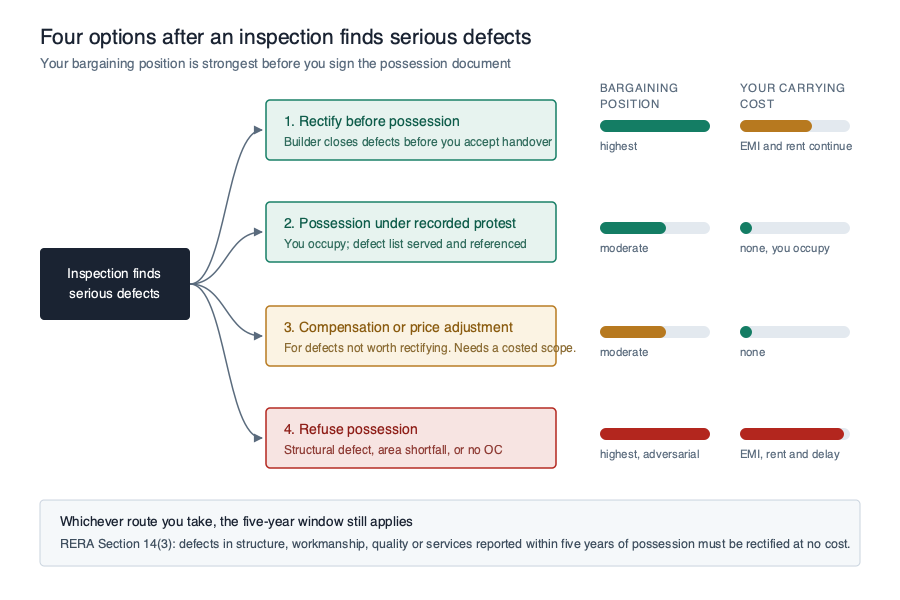
The four options compared
| Option | Your bargaining position | Your cost | Best when |
|---|---|---|---|
| Rectify before possession | Highest, the builder’s closure is blocked | EMI and rent continue during the delay | Defects are fixable and the builder is responsive |
| Possession under recorded protest | Moderate, moves into the defect liability process | None; you occupy | Defect list is long but rectifiable |
| Compensation or price adjustment | Moderate | None | Defects are permanent or not worth re-doing |
| Refuse possession | Highest, but adversarial | EMI, rent and delay continue | Structural inadequacy, material area shortfall, or no occupancy certificate |
Most defect lists are long but fixable. For those, possession under a properly recorded protest gets you into your home without surrendering the claim. Refusal is the right tool for a narrower set of cases.
Option 1: Rectification before possession
Ask for the defects to be closed before you accept handover. This is the default and the strongest route.
Make the request as a numbered defect register rather than a conversation, sorted by severity, each item naming the room, the defect and the standard it breaches where applicable. Ask for a written rectification schedule with dates.
The failure mode here is delay. Every week of rectification is a week of EMI and rent for you and no cost to the builder, which is why the register should carry dates and why you should agree in advance what happens if they slip.
Option 2: Possession under recorded protest
You take the keys, but you formally record that you do not accept the property’s condition. Done properly this preserves your position. Done casually it is indistinguishable from simply taking possession.
Doing it properly means four things:
- An independent, dated inspection report with measurements and photographs, produced before you sign anything
- The defect register served formally to the builder by email, with written acknowledgement retained
- Wording on the possession document itself stating that possession is accepted subject to the attached defect list dated [date], with a countersigned copy kept
- A rectification timeline in writing, item by item where possible
The most common and most costly mistake is signing a clean handover form declaring satisfaction with the condition, and raising defects by email afterwards. The signed clause is what the builder will point to.
Option 3: Compensation or price adjustment
Some defects are not worth rectifying. A finish that cannot be matched, a layout deviation, or a specification substitution already installed throughout the flat may be better resolved financially than physically.
To negotiate credibly you need a number, which means a repair cost estimate rather than a complaint. An inspection report that quantifies the remedial scope gives you that. Ask for the adjustment in writing and ensure it is reflected in the final settlement rather than promised verbally.
Option 4: Refusing possession
Refusal is appropriate in a narrower set of circumstances:
- Structural inadequacy assessed by a qualified engineer, rather than cosmetic defects
- Material shortfall in carpet area against the area stated in your agreement, as defined under RERA
- Specification substitution materially below what the agreement specified
- No occupancy certificate, meaning the building is not certified for occupation
- Core services not functional at handover: water, sewage, power or lift
Refusing is a negotiating position with a running cost. Your EMI continues, any rent you pay elsewhere continues, and the builder may dispute whose delay it is. Take legal advice before refusing, and record the refusal and its grounds in writing.
What stays true whichever option you choose
The builder’s obligation does not end at handover. Under Section 14(3) of RERA, structural defects and defects in workmanship, quality or provision of services reported within five years of possession must be rectified by the promoter at no additional cost, with compensation payable where rectification does not occur.
That protection is real, and it is why documentation at handover matters so much. A defect recorded in a dated third-party report before you held the keys is straightforward to attribute to construction. The same defect raised in month eighteen invites an argument about whether it was caused by use.
How to prioritise a long defect list
Not every item deserves the same fight. A workable order:
- Safety and structure first. Electrical earthing faults, structural cracks, unsafe railings, gas or lift issues.
- Water second. Leaks, reverse falls in wet areas, waterproofing failures, dampness. Water defects worsen and damage other finishes.
- Services third. Plumbing pressure, drainage, ventilation, non-functional fittings.
- Finishes last. Tiles, paint, joinery, hardware. Numerous, visible, and the easiest to rectify.
Builders tend to close the easy finishing items first because it shortens the list. Insisting on severity order rather than count order is the single most useful thing you can do when managing rectification.
PropChk has completed 45,000+ inspections across 550+ projects in 10+ cities, with inspection processes designed in partnership with IIT Roorkee. The patterns described above are the ones our engineers record most often at handover.
Related reading
- Defect liability period
- Snagging in construction: ensuring quality before handover
- RERA carpet area and built-up space
The text of the RERA Act is available from India Code.
Frequently asked questions
What should I do if a home inspection finds serious defects?
Choose between four routes: rectification before possession, possession under a formally recorded defect list, compensation, or refusal. Rectification before possession is the strongest of the four. Whichever you choose, serve a written, numbered defect register and keep the acknowledgement.
Can I claim compensation for defects instead of repairs?
Yes, where a defect is impractical to rectify or where you would rather resolve it financially. You need a costed remedial scope to negotiate credibly, and the adjustment should be recorded in writing rather than agreed verbally.
How long does the builder remain liable for defects?
Five years from the date of possession, under Section 14(3) of RERA, for structural defects and defects in workmanship, quality or provision of services. The promoter must rectify at no additional cost, or compensation is payable.
Does taking possession mean I have accepted the defects?
Not if you record them. Taking possession does not extinguish the five-year defect liability, but signing a clean satisfaction clause weakens your position on individual items. Record the defect list and reference it on the possession document.
What if the builder fixes some items and ignores others?
Re-inspect and re-issue the register showing which items remain open, with dates. A defect list that is maintained and re-served is far harder to ignore than one raised once. Unresolved items can be escalated to your state RERA authority.
Should I get an independent inspection or use the builder’s checklist?
The builder’s pre-delivery check is their quality process, not your assessment. An independent report is the document that carries weight in a dispute, because its author is not paid by the party responsible for the defects.