

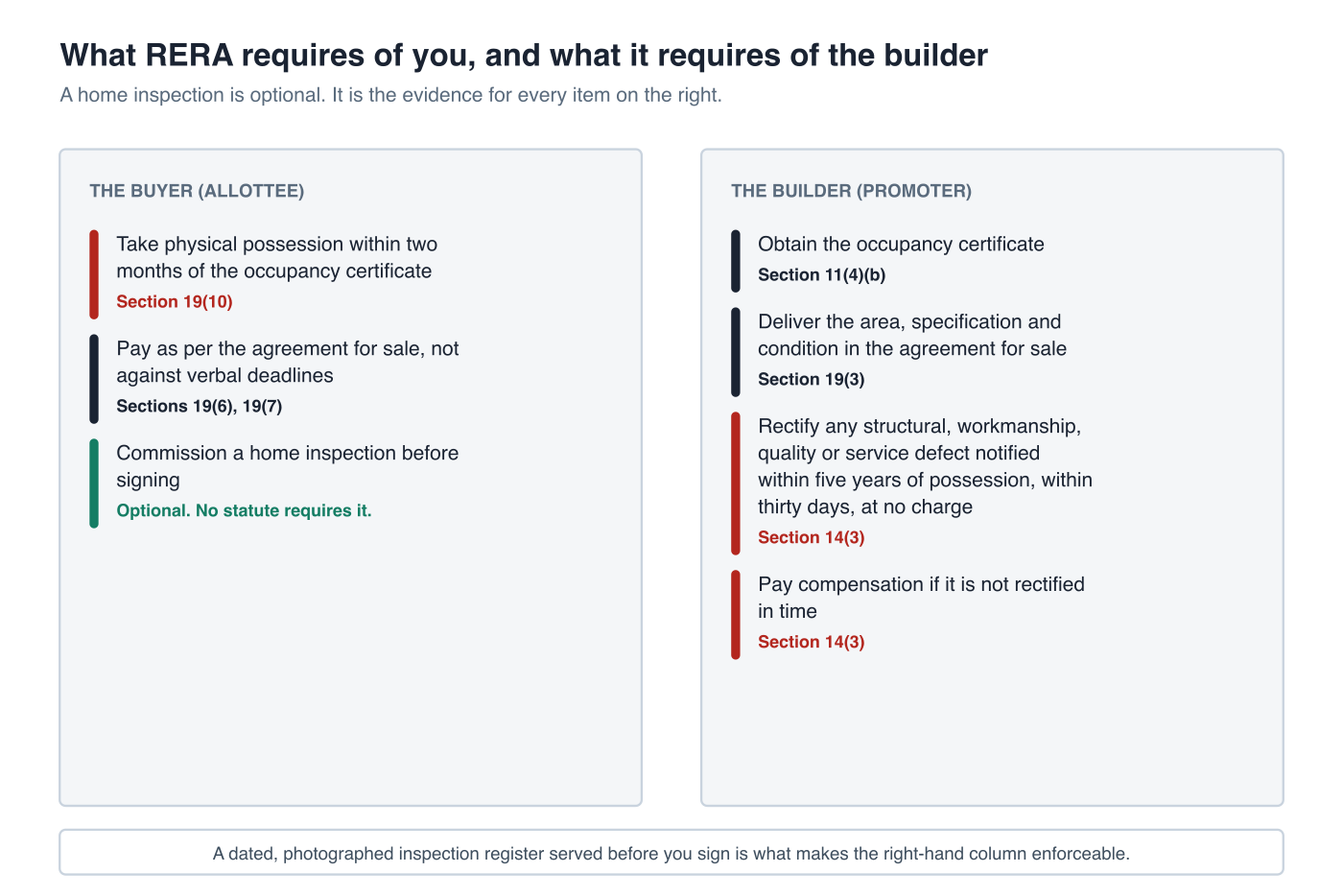
No Indian law requires a buyer to commission a home inspection before taking possession. What the law does give you is a five-year window after possession in which the builder must rectify structural and workmanship defects within thirty days of notice, at no charge, under Section 14(3) of the Real Estate (Regulation and Development) Act, 2016. It also puts a clock on you: Section 19(10) requires the allottee to take physical possession within two months of the occupancy certificate. An inspection is optional. The rights it helps you prove, and the deadline it helps you meet, are not.
That distinction is where most buyers lose money. They treat the inspection as a formality they can skip, then discover the defect after signing, when the burden of showing it existed at handover has shifted onto them.
What the law actually says
There is no statutory inspection requirement for buyers
The Real Estate (Regulation and Development) Act, 2016, known as RERA, does not oblige a homebuyer to appoint an inspector. Nothing in a standard agreement for sale requires it either. If a builder or broker tells you an inspection is “not allowed” or “not part of the process”, they are describing a preference, not a legal position.
The builder carries a five-year defect liability with a thirty-day repair clock
Section 14(3) of RERA says that if any structural defect, or any other defect in workmanship, quality or provision of services, or any other obligation of the promoter under the agreement for sale, is brought to the promoter’s notice by the allottee within five years from the date of handing over possession, the promoter must rectify it without further charge within thirty days. If the promoter fails to do so within that time, the allottee is entitled to compensation under the Act.
Three details in that clause matter more than the headline number. The five years run from the date of handing over possession, not from the occupancy certificate. The repair clock is thirty days from notice, so the notice itself has to be dated and provable. And the clause covers workmanship, quality and services, not only structure, which is why a tile lippage or a leaking joint is inside it.
You have a two-month window to take possession after the occupancy certificate
Section 19(10) requires every allottee to take physical possession of the apartment, plot or building within two months of the occupancy certificate being issued. Section 11(4)(b) puts the duty to obtain that certificate on the promoter. Together these mean the handover period is not open-ended. The inspection has to happen inside that window, and the defect register has to be served before you sign the possession documents, not after.
You are entitled to inspect before you accept
Handover is a two-sided act. The builder offers possession; you accept it. Section 19(3) entitles the allottee to claim possession as per the agreement, and the agreement describes what is being delivered: area, specification and condition. You are not obliged to sign a clean possession letter for a flat that does not match it. Most agreements describe a handover or snagging visit; that visit is where an inspection belongs. If the agreement is silent on third-party inspectors, silence is not prohibition.
Mandatory or advisable: a plain table
| Question | Answer |
|---|---|
| Is a buyer legally required to inspect? | No. |
| Can a builder legally refuse a third-party inspector? | No clause in RERA or a standard agreement for sale gives that right. Ask for the refusal in writing. |
| Does the builder owe you defect rectification? | Yes. Five years from possession, thirty days from notice, at no charge, under Section 14(3). |
| Does that obligation depend on having inspected? | No. But proving a defect existed at handover is far easier with a dated report. |
| How long do you have to take possession? | Two months from the occupancy certificate, under Section 19(10). |
| Best time to inspect | Before signing the possession letter, inside that two-month window. |
| Second-best time | Immediately after possession, while the five-year liability is fresh and the flat is unoccupied. |
Why optional still means do it
Three practical reasons, in order of how much they cost.
- Leverage collapses at signature. Before you accept possession, an unresolved snag is the builder’s problem and it holds up their closure. After you accept, it is your service request in a queue. The work is the same; the urgency is not.
- Proof gets harder. The five-year window turns on showing the defect is a construction defect rather than owner damage or wear. A dated report from an independent engineer, made before you held the keys, settles that in advance. Raise the same defect in month eighteen and you are in an argument about causation.
- Some defects are invisible on a walk-through. Concealed dampness, hollow tiles, reversed polarity on a socket, a drainage slope that runs the wrong way and inadequate earthing do not announce themselves on a Sunday viewing. They announce themselves in the first monsoon. A moisture meter, a thermal scanner and a socket tester find them in an afternoon. Our guide to the hidden defects a home inspection uncovers lists the common ones.
What to do instead of asking whether it is mandatory
- Ask for the handover date in writing, with enough notice to arrange an inspection. Two weeks is reasonable. Three days is common; if that is what you have, our guide to inspecting with three days to possession covers what still gets done.
- Tell the builder in writing that a technical consultant will accompany you to the handover inspection. Keep the reply.
- Inspect before you sign anything. Have power, water and access arranged so every system can actually be tested.
- Get a dated defect register, numbered by severity, with photographs and measurements, and serve it on the builder formally, by email, the same day.
- Sign with the register attached. The possession letter should state that possession is accepted subject to the annexed defect list dated that day. Do not sign a clause saying you are satisfied with the condition while holding an open list.
- Rectify, then re-inspect. Do not close a snag on the builder’s word. Our guide to tracking builder repairs with a snag list covers the follow-through.
- Keep everything. The report, the emails, the acknowledgement. That file is what the thirty-day clock and the five-year window run on.
If the builder refuses access
This usually arrives framed as policy rather than refusal. Three steps:
- Put the request in an email naming the date and the consultant, and ask for written confirmation or written refusal.
- If refused, ask which clause of the agreement for sale prohibits it. There generally is not one.
- If access is still denied, the refusal itself becomes documentation. A complaint to the state RERA authority under Section 31 is open to any aggrieved allottee. Do not take possession under protest without recording the protest in writing on the possession document.
If the inspection has already found major defects and you are deciding whether to sign at all, our guide on refusing possession after an inspection walks through both routes.
How PropChk fits into this
PropChk is an independent, third-party home inspection company, founded in January 2022, with no affiliation to any developer, agent or seller. Inspections are carried out by qualified civil, electrical and mechanical engineers against protocols designed with IIT Roorkee, using moisture meters, thermal scanners, laser meters, TDS meters and socket testers, and every finding is photographed into a dated report. Re-inspection after the builder’s rectification is a separate service, so closed items are verified rather than assumed. PropChk operates in Delhi NCR, Mumbai, Pune, Bengaluru, Hyderabad and Chennai. You can read the home inspection scope, estimate the price or book a slot ahead of your handover date.
Frequently asked questions
Is a home inspection legally required before possession in India?
No. There is no statutory obligation on a buyer to commission an inspection. What is not optional is the builder’s duty under RERA Section 14(3) to rectify structural, workmanship, quality and service defects notified within five years of possession, within thirty days and at no charge.
Can a builder stop me from bringing an independent inspector?
There is no basis in RERA or in a standard agreement for sale for refusing a buyer’s technical consultant at handover. Make the request in writing and keep the response. A written refusal is useful evidence if you later escalate to the state RERA authority.
How long after possession can I raise a defect?
Five years from the date of handing over possession, under Section 14(3). The builder then has thirty days from your notice to rectify, failing which you are entitled to compensation.
How long do I have to take possession once the occupancy certificate is issued?
Two months, under Section 19(10). Plan the inspection inside that window and serve the defect register before the possession letter is signed.
Does taking possession waive my right to raise defects?
No. The five-year liability survives possession. What changes is proof: a defect on a dated pre-handover report is attributable to construction; one first raised months later invites an argument about use.
Should I inspect a resale flat too?
Yes, for a different reason. RERA’s defect liability runs from the original possession date and sits with the promoter, so on a resale you are inspecting to price the property and plan repairs, not to enforce a builder obligation.
This article explains general legal principles and is not legal advice. Provisions and their application vary by state RERA rules and by the terms of your agreement for sale. Reviewed by PropChk’s engineering team, 18 September 2026.
Sources
- The Real Estate (Regulation and Development) Act, 2016, Sections 11(4)(b), 14(3), 19(3), 19(10) and 31: indiacode.nic.in
- Ministry of Housing and Urban Affairs, RERA: mohua.gov.in