

Yes. Uneven floor tiles in a newly handed-over flat are a workmanship defect, and under Section 14(3) of the Real Estate (Regulation and Development) Act, 2016 the builder must rectify defects in workmanship reported within five years of possession, at no cost to you. The practical difficulty is not liability but evidence, because “the tiles look uneven” is easy to dismiss and a measured lippage figure is not.
What counts as an uneven tile
Tile unevenness shows up in three distinct forms, and they have different causes and different fixes.
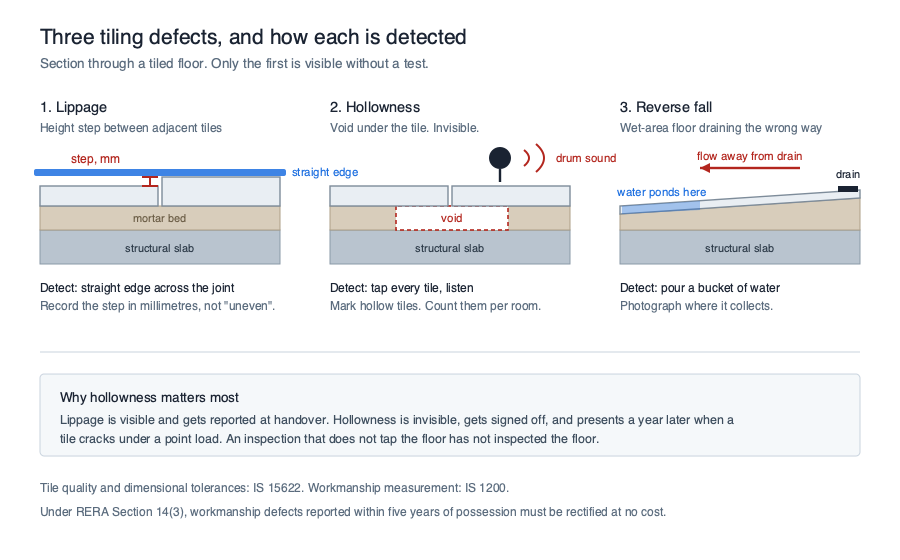
Lippage is a height difference between the edges of two adjacent tiles, felt as a lip underfoot. It is caused by uneven bedding mortar, tiles laid on an unlevelled screed, or tiles of varying thickness laid together.
Hollowness is a void between the tile and the bed beneath it, detected by tapping the tile and hearing a drum-like sound rather than a solid one. It is caused by insufficient mortar coverage. Hollow tiles crack under point loads and lift over time, and they are the most under-reported tiling defect at handover.
Slope and level error is the floor as a whole running out of level, or running the wrong way. In a bathroom or balcony this matters more than appearance: the floor must fall towards the drain, and a reverse fall means standing water permanently.
The evidence that gets it fixed
Builders respond to measurements. Photographs of a floor rarely show lippage at all.
| What to record | How | Why it works |
|---|---|---|
| Lippage | Straight edge across the joint, measure the step in millimetres | Converts a subjective complaint into a number |
| Hollowness | Tap every tile with a wooden mallet or coin; mark the hollow ones | Produces a count and a map, not an impression |
| Level and slope | Spirit level or laser across the room; water test in wet areas | Shows reverse falls objectively |
| Location | Room, and distance from a fixed reference such as a doorway | Lets the builder find the exact tile |
| Extent | Number of affected tiles as a share of the room | Distinguishes a snag from a re-laying job |
The water test is the most persuasive thing you can do in a bathroom or balcony. Pour a bucket of water and photograph where it collects. A floor that ponds instead of draining is not an opinion.
Why hollowness matters more than lippage
Lippage is a trip hazard and a visible defect. Hollowness is a structural weakness in the floor finish that presents later, usually after possession, when a tile cracks under a chair leg or lifts at a corner. Because it is invisible without tapping, it is the defect most often signed off at handover and disputed a year later.
An inspection that does not tap the floor has not inspected the floor. At PropChk, tile assessment during a handover inspection covers full-area tapping for hollowness, lippage measurement at random joints across each room, level and slope readings, and a wet-area water test, with the results recorded per room rather than as a single line item.
Ceramic and vitrified tile quality and dimensional tolerances in India are covered by IS 15622, and workmanship measurement by IS 1200. Ask which standards your inspection report references.
What to do, in order
- Inspect before you take possession. Once you have signed a clean possession document, tile defects move from a handover condition to a warranty claim, which is slower.
- Tap the whole floor, room by room, and mark hollow tiles with removable tape. Count them.
- Measure lippage where you can feel a step, and photograph the straight edge and the gap together.
- Water-test every wet area and photograph any ponding.
- Submit a written defect register, room by room, with counts, measurements and photographs. Ask for written acknowledgement.
- Ask what the rectification method will be. Grinding a lipped edge and re-grouting hides the problem. Hollow tiles need lifting and re-laying.
- Re-inspect after the work. Tap again. Re-laid tiles are frequently hollow too.
If the builder pushes back
The two most common responses are that the unevenness is within tolerance, and that it is a subjective complaint.
For the first, ask which tolerance and which standard, in writing. A builder citing a tolerance has accepted that a measurable threshold exists, which moves the conversation onto ground where your measurements matter.
For the second, your tapping map and lippage measurements answer it directly. This is why the numbers are worth collecting before the conversation, not after it.
If defects remain unrectified, Section 14(3) of RERA gives you a five-year window from possession in which the promoter must rectify at no cost, with compensation payable where rectification does not happen. Unresolved matters can be escalated to your state RERA authority.
PropChk has completed 45,000+ inspections across 550+ projects in 10+ cities, with inspection processes designed in partnership with IIT Roorkee. The patterns described above are the ones our engineers record most often at handover.
Related reading
- 15 things to check before taking possession
- Snagging in construction: ensuring quality before handover
- Defect liability period
Indian Standards referenced here are published by the Bureau of Indian Standards.
Frequently asked questions
Are uneven tiles a construction defect?
Yes. Uneven tiles are a workmanship defect arising from poor bedding, an unlevelled screed, or mixed tile thicknesses. Under RERA Section 14(3) the builder is obliged to rectify workmanship defects reported within five years of possession.
What is tile lippage?
Lippage is the height difference between the edges of two adjacent tiles, felt as a step underfoot. It is measured by laying a straight edge across the joint and measuring the vertical difference in millimetres.
How do I check if tiles are hollow?
Tap each tile with a wooden mallet or a coin and listen. A solid, dull sound means the tile is fully bedded. A hollow, drum-like sound means there is a void beneath it. Mark the hollow tiles and count them, room by room.
Can hollow tiles be repaired without replacing them?
Injection grouting is sometimes offered, but for a floor with widespread hollowness the durable fix is lifting and re-laying with full mortar coverage. Ask for the method in writing before work starts, and re-tap afterwards.
How much lippage is acceptable?
Acceptable limits depend on tile size, joint width and the specification in your agreement. Rather than arguing an abstract figure, record your measured values and ask the builder in writing which tolerance and which standard they are applying.
Is the builder responsible if I noticed the tiles only after moving in?
Yes, within the five-year defect liability window under RERA Section 14(3). Noticing later makes attribution harder, which is why a dated inspection report at handover is worth having, but it does not remove the obligation.
Should I refuse possession over tile defects?
Usually not. Tiling is rectifiable, and refusing possession carries real costs in EMI and rent. The stronger position is to accept possession under a formally recorded defect list rather than signing a clean satisfaction clause.